Bullseye Get the app
Solver technical detail

How your Hit Probability is worked out

Your Hit Probability is the odds that a shot lands on the target. Bullseye estimates how far each source of error could move the bullet. It combines them into one pattern around your aim point and works out how much of that pattern lands on the target.

likely pattern aim point target: 8 in plate
On target Off target Where most shots land
Inputs

Today's conditions

Your Hit Probability uses the same inputs as your firing solution:

  • AirToday's temperature, pressure, humidity and altitude. It also uses the air on the day you zeroed, if you entered it.
  • WindThe wind speed and direction.
  • GeometryShot angle, latitude and direction of fire.
  • Muzzle velocityAdjusted for powder temperature, cold or clean bore, barrel wear and truing.

Conditions don't raise or lower your Hit Probability by themselves, because the pattern is centered on your solution. What they change is how much each error costs.

Thinner air
Thinner air means less drift per mph.
Stronger wind
A stronger wind makes a wrong direction call cost more.
Longer shot
A longer shot makes every error cost more.
Error budget

The errors it plans for

ErrorPlanned forNotes
Wind speed misread3 mphYou can change this in Settings.
Wind direction misread½ clock hour
Range error0.5%Of the distance.
BC error1%
Muzzle velocity spread15 fpsOr your load's measured spread, if you choose to use it.

WindThe wind setting doesn't follow the weather. A gusty, switching wind gets the same 3 mph as a steady one unless you raise it.


Your spread

Your own accuracy

Bullseye also needs to know how tightly you and your rifle group. It uses the best source you have, in this order:

  1. Your measured groups Shown as: measured

    These are groups with this rifle and load, five shots or more each. One group is enough to start, and the result is marked provisional until you have three.

    Bullseye removes the part of the spread your velocity variation already explains, so it isn't counted twice. It uses how tight your groups are, not where they landed.

  2. Your called shots Shown as: from called shots

    With no measured group yet, Bullseye uses the misses in your shot log. It counts warm-bore shots only, and only misses where you said how far off the shot was. It needs at least five each way, up and down and left and right.

    A called miss already includes that shot's velocity and wind error, so those aren't added again.

  3. An estimate Shown as: estimated

    With neither, Bullseye assumes 1 MOA each way and marks the result "estimated."

Measured groups always win over called shots, and the two are never mixed. Once you have one five-shot group, your shot log no longer changes this number.

Measure your groups so your Hit Probability uses your real accuracy.

  • 5-shot groups minimum
  • 10-shot groups are better
  • 20-shot groups are honest

Reading the card

Hit probability display

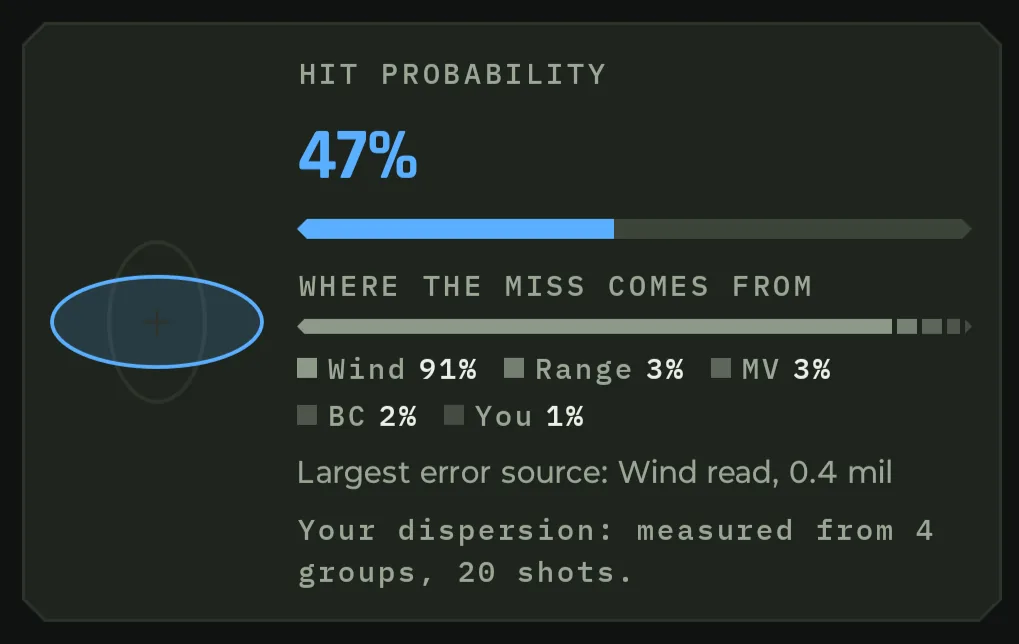
  • The number. Your chance of a first-round hit on that target, from 1% to 99%. The app never rounds to a sure thing, or to no chance at all.
  • The picture. The gray outline is your target. The blue ellipse is where most of your shots would land. When the ellipse spills past the sides, the miss will be left or right. When it spills past the top or bottom, it will be high or low.
  • Where the miss comes from. Each source's share of the miss: wind read, range, muzzle velocity, BC, and you. The biggest one is named, with how far it can move the shot.
  • Your own groups. The "You" share comes from the groups you've measured with this rifle and load. Until you've measured one, the app uses your called shots or an estimate, and says which.

So you know what to work on: when wind is 91% of the miss, a better wind read pays off far more than a better rest. And you can decide before the shot whether to take it, wait for the wind to settle, or pick a bigger target.

Hit probability card from Bullseye Ballistics showing 47%. A blue ellipse of likely impacts is wider than the gray outline of an 18×30 in silhouette target. A bar splits where the miss comes from: wind 91%, range 3%, muzzle velocity 3%, BC 2%, shooter 1%. Largest error source: wind read, 0.4 mil. Dispersion measured from 4 groups, 20 shots.
In this example An 18×30 in silhouette at 1,024 yd in a 4.8 mph full-value wind: a 47% shot, and 91% of the miss is the wind call.